Personalise your H. pylori test
Add to your test
3 add-ons availableTotal price:
£93.00
Includes our
Helicobacter pylori Test
H. pylori affects 1-in-5 of us and might be to blame for stomach pain around mealtimes, bloating and / or nausea.
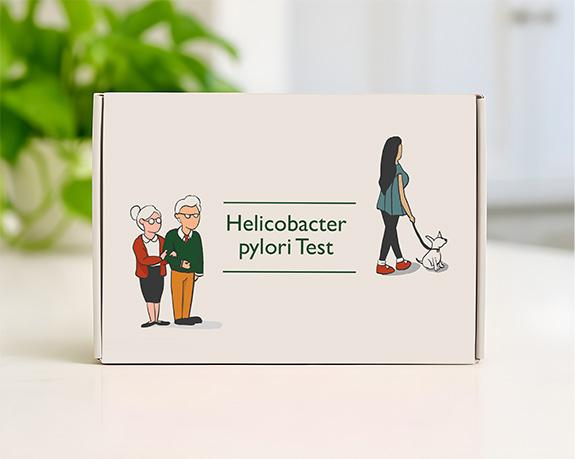
Our Helicobacter pylori test is a quick and easy stool test for H. pylori. Simply take a stool sample at home, send it to our UKAS-accredited lab and you’ll get your result and doctor’s report in days.
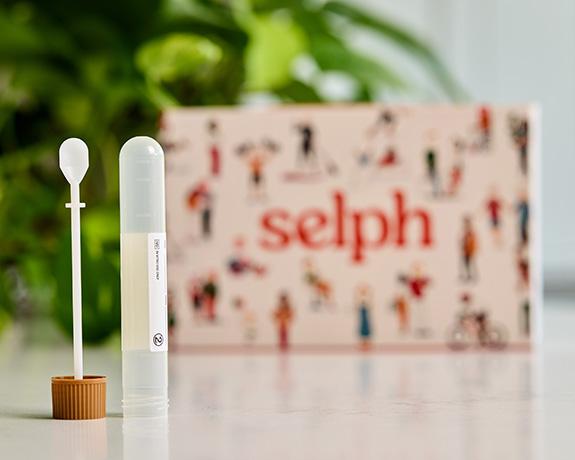
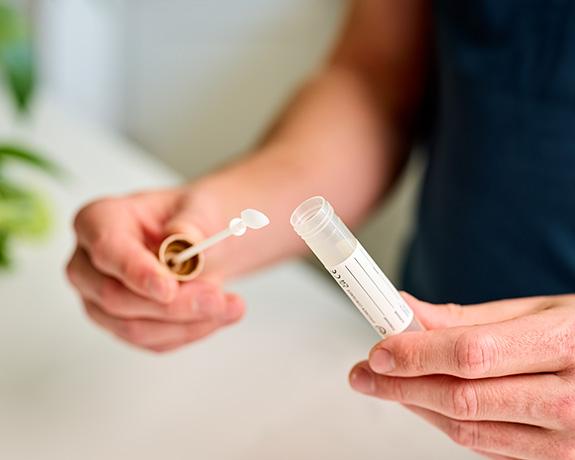
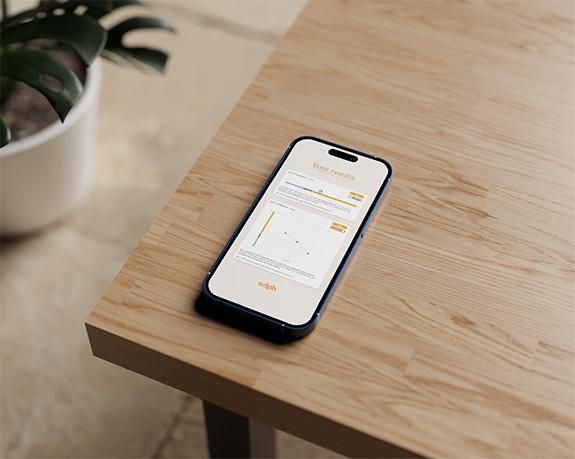
 Results and doctor's report in 4 days or less
 Free, next-working day delivery
 Testing for Helicobacter pylori stool antigen
Written by Dr Alasdair Scott PhD, GMC-registered doctor and bowel cancer surgeon.
What you need to know about our Helicobacter pylori Test
Helicobacter pylori (H. pylori) is a very common stomach infection which causes inflammation (gastritis) and indigestion. It also increases the risk of stomach ulcers and stomach cancer.
You'll take your sample at home and send it to our accredited lab for analysis of H. pylori stool antigen. You'll get your results and a lab report you can share with your doctor if needed.
What do the H. pylori test results mean?
There are three possible results from an H. pylori stool antigen test:
- Negative - you don't have H. pylori infection
- Positive - you do have H. pylori infection and should be treated
- Borderline - some H. pylori antigen was detected but not as much as we usually see with a clear positive. This might be partially treated H. pylori infection or early stage infection. You might need to repeat the test in a few weeks.
What are the symptoms of H. pylori infection?
Most people with H. pylori infection actually do not have any symptoms.
The commonest symptoms of H. pylori infection are:
- Indigestion - pain or discomfort in the stomach shortly before or after eating
- Bloating and belching
- Feeling sick or nauseous
- Uncomfortable fullness after eating
- Diarrhoea and floating stools
How the H. pylori test works
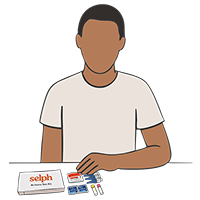
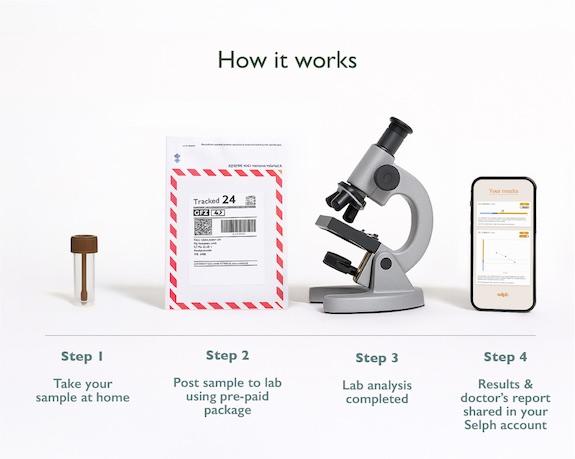
Do your H. pylori stool test
You'll get your kit next-working day.
Collect your stool sample at home using the simple H. pylori test kit and post it back to our UKAS-accredited lab for analysis.
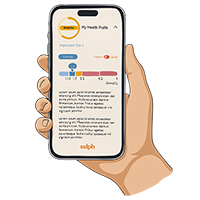
Get results quickly
Once the lab has your sample, you'll get your Helicobacter pylori stool antigen test results quickly.
You'll also get a doctor's report explaining in clear, everyday language whether H. pylori has been detected and what the next steps are.

Get treated
If you have a positive H. pylori results you can book a consultation with one of our gut health experts to arrange treatment (costs extra). Alternatively you can download your results to share with your GP.
Helicobacter pylori Test FAQs
Proton pump inhibitor (PPI) medication, such as lansoprazole or omeprazole can make the H. pylori stool test less accurate. If you take PPIs you should stop this at least 2 weeks before testing. It is usually safe to stop this medication for a short period of time, but if you're not sure, speak to your prescriber.
We do not recommend using this test panel if you are a child (17 years or under) unless supervised by an adult. If you are using this test to confirm eradication of H. pylori after treatment, you should wait a minimum of 6 to 8 weeks after finishing treatment before taking the test.
If you're unsure if you should use this test panel, please contact us for advice.
Our tests are analysed by The Doctors Laboratory (TDL). TDL are one of the largest laboratories in the UK and perform testing for the NHS (e.g. University College Hospital London) and private providers such as ourselves. The exact same testing platforms and procedures are used in either case.
But no test is perfect - there can always be "false positive" and "false negative" results. The H. pylori stool antigen test has 95.5% sensitivity and 98.6% specificityref. This gives a 4% false negative rate and a 1.4% false positive rate.
H. pylori causes inflammation in the stomach (gastritis) and, over time, this chronic inflammation can cause stomach cancer. However, millions of people around the world are infected with H. pylori but very few (around 1-3 in every 100) develop stomach cancer. You'd need to be infected with H. pylori for years for a stomach cancer to develop. Studies have shown that treating H. pylori effectively reduces the risk of developing stomach cancer.
H. pylori infection is very common and it's though to affect up to 1-in-5 people in the UK. H. pylori is a contagious bacterium and can spread directly from person-to-person via saliva, vomit or stool. It commonly spreads within households, so you're at higher risk if someone else in your household is infected. H. pylori also spreads through contaminated food and water.
Your results and doctor’s report are usually available within 4 working days of your sample arriving at the laboratory. This does not include delivery time, weekends or bank holidays. We’re often faster, but this timeframe is not a guarantee. Adding tests to your panel may occasionally mean that some results take longer.
Still have questions?
If you have any questions, we're here to help. Our customer service team is hands-down the best you'll ever deal with. They're smart, friendly, knowledgeable and will get back to you in a flash.